
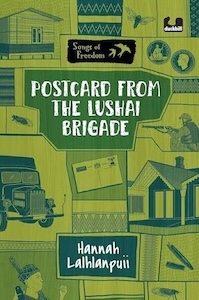
This enthralling story is part of Duckbill’s Songs of Freedom series, which features stories of children navigating life across different parts of India during the struggle for independence. The novel follows thirteen-year-old Bawiha, who lives with his grandmother (Api), mother, and adored older brother Kima, growing up in the Lushai Hills during World War II and the impending Japanese invasion. The narrative is set between 1942 and 1944 in Aizawl, the capital of Mizoram (then known as the Lushai Hills). Bawiha lives in a world of simple joys, heavily influenced by his grandmother’s traditional folklore and stories of magical heroes. His mother and he work hard at the bungalow of the British Superintendent, Mr. McCall. While some locals deeply resent the British colonial presence, it initially does not disrupt Bawiha’s innocence. The story shifts dramatically when the realities of World War II reach the Indian border. As Japanese forces sweep through neighboring Burma and prepare to invade northeast India, the local region is thrown into turmoil. Kima decides to enlist in the British Indian Army to defend their home, abruptly ending Bawiha’s carefree childhood. The title of the book refers to the poignant postcard and communication Kima sends home after joining the brigade, altering Bawiha’s perception of what it truly means to be a hero.
Title: Postcard From The Lushai Brigade
Author: Hannah Lalhlanpuii
Publisher: Duckbill, an imprint of Penguin Random House India
Copyright: 2023
Original Language: English
ISBN: 978-80143-45938-5
Paperback pages: 112
Age range: 10 up
Genre: Historical fiction
Book setting: Aizawl, Mizoram, India (Lushai Hills)
Author’s ethnicity: Indian
Author’s residence: Aizawl
Awards: 2026 IBBY (International Board on Books for Young People) Honor List
Subjects: British army, British occupation, Folklore, Japan, Indian army, Northeast India, World War II

 Rumi (1207-1273) was a poet, an Islamic scholar, and a Sufi mystic. He wrote in Persian/Farsi. He is one of the best-known and most widely-read poets in the world. As a child, he was enchanted by birds and books. He loved to play and dance in the garden. He had many questions, which his father answered patiently. When Rumi was older, he met Attar the great Persian poet. He read Attar’s epic poem called “The Conference of Birds” and searched for its deeper meaning. Years, later, Rumi moved to Turkey, where he met Shams, who was a great Persian spiritual teacher. Shams was a sun shining in Rumi’s heart and mind. Later, Rumi wrote his poetic masterpiece, “The Masnavi.” He also loved telling stories to children. “Be a friend to everyone” was his great message. This touching picture book biography radiates Rumi’s wisdom and warmth. Strong colors and ornamental details in the glorious illustrations feature traditional Persian clothing and motifs and distinguish the story. Back matter includes an author’s note and more information about Rumi. mjw


 In 1934, a young man named Vango on the cusp of taking priestly vows is suddenly made a fugitive. Accused of murder, pursued by police and mysterious others, Vango finds that proving his innocence involves uncovering secrets from his past, taking him from Parisian rooftops to Mediterranean islands to Scottish forests in a hyper-coloured spy-thriller with a backwards-and-forwards timeline. Part of the book’s charm involves historic figures turned into characters – like Hugo Eckener (commander of the Graf Zeppelin) who de Fombelle has written as a friend of Vango and as a quick-witted protester to Hitler’s increasing regime. Snippets of story are also told from the perspective of a young girl who turns out to be Stalin’s daughter. These historic guess-who’s never felt clunky. With a larger-than-life protagonist, Vango will appeal to lovers of daring escapades. The mystery to his identity unravels in the sequel, Vango, Book 2, A Prince Without A Kingdom, published in 2105. ew


