
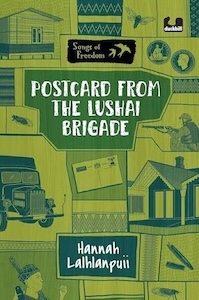
This enthralling story is part of Duckbill’s Songs of Freedom series, which features stories of children navigating life across different parts of India during the struggle for independence. The novel follows thirteen-year-old Bawiha, who lives with his grandmother (Api), mother, and adored older brother Kima, growing up in the Lushai Hills during World War II and the impending Japanese invasion. The narrative is set between 1942 and 1944 in Aizawl, the capital of Mizoram (then known as the Lushai Hills). Bawiha lives in a world of simple joys, heavily influenced by his grandmother’s traditional folklore and stories of magical heroes. His mother and he work hard at the bungalow of the British Superintendent, Mr. McCall. While some locals deeply resent the British colonial presence, it initially does not disrupt Bawiha’s innocence. The story shifts dramatically when the realities of World War II reach the Indian border. As Japanese forces sweep through neighboring Burma and prepare to invade northeast India, the local region is thrown into turmoil. Kima decides to enlist in the British Indian Army to defend their home, abruptly ending Bawiha’s carefree childhood. The title of the book refers to the poignant postcard and communication Kima sends home after joining the brigade, altering Bawiha’s perception of what it truly means to be a hero.
Title: Postcard From The Lushai Brigade
Author: Hannah Lalhlanpuii
Publisher: Duckbill, an imprint of Penguin Random House India
Copyright: 2023
Original Language: English
ISBN: 978-80143-45938-5
Paperback pages: 112
Age range: 10 up
Genre: Historical fiction
Book setting: Aizawl, Mizoram, India (Lushai Hills)
Author’s ethnicity: Indian
Author’s residence: Aizawl
Awards: 2026 IBBY (International Board on Books for Young People) Honor List
Subjects: British army, British occupation, Folklore, Japan, Indian army, Northeast India, World War II


 Narrated by a young refugee, this beautiful and realistic picture book tells about having to leave home and the healing power of hope. The girl and her mother used to live in an apartment with a star-shaped lamp in their window. In their new country, everything is different – the language, their apartment, and the food. One day, the mother brings home art supplies so that they can make a cardboard star just like the one they had back home. That helps to make their new place feel a little more like home. The penultimate page shows the girl with a new friend, both carrying their musical instruments. The mostly blue and yellow illustrations were created with hand drawn contours and Photoshop. An author’s note explains that the book was inspired by Desnitskaya’s experience leaving Russia after the start of the Ukraine War. It is the author’s hope that his book can help children from different countries who have lost their homes to start loving the place where they were forced to be.
 Set in 1980s Vietnam, Tho and his best friend, Lam, love cricket fighting, and soccer, but there is fear in his village that twelve-year-old boys, like them, will be conscripted into the Communist army. People are trying to leave Vietnam and move to safer countries. One day, Lam and his brother disappear. Tho’s family sells their furniture to make money to send Tho and his brother, Vu, away. Vu leaves first and a year later Tho boards a small boat to escape. He stows away on a pirate boat, crosses the South China Sea, and eventually gets to a refugee camp in Palawon in the Philippines, where he stays for six months. Finally, a Canadian elementary school teacher adopts him and he flies to his new home in Toronto. This harrowing story is based on true events in the author’s life. A map, a pronunciation guide, an afterword, and a brief recent history of Vietnam further enhance Tho’s intense account of his journey.


