
 In 1934, a young man named Vango on the cusp of taking priestly vows is suddenly made a fugitive. Accused of murder, pursued by police and mysterious others, Vango finds that proving his innocence involves uncovering secrets from his past, taking him from Parisian rooftops to Mediterranean islands to Scottish forests in a hyper-coloured spy-thriller with a backwards-and-forwards timeline. Part of the book’s charm involves historic figures turned into characters – like Hugo Eckener (commander of the Graf Zeppelin) who de Fombelle has written as a friend of Vango and as a quick-witted protester to Hitler’s increasing regime. Snippets of story are also told from the perspective of a young girl who turns out to be Stalin’s daughter. These historic guess-who’s never felt clunky. With a larger-than-life protagonist, Vango will appeal to lovers of daring escapades. The mystery to his identity unravels in the sequel, Vango, Book 2, A Prince Without A Kingdom, published in 2105. ew In 1934, a young man named Vango on the cusp of taking priestly vows is suddenly made a fugitive. Accused of murder, pursued by police and mysterious others, Vango finds that proving his innocence involves uncovering secrets from his past, taking him from Parisian rooftops to Mediterranean islands to Scottish forests in a hyper-coloured spy-thriller with a backwards-and-forwards timeline. Part of the book’s charm involves historic figures turned into characters – like Hugo Eckener (commander of the Graf Zeppelin) who de Fombelle has written as a friend of Vango and as a quick-witted protester to Hitler’s increasing regime. Snippets of story are also told from the perspective of a young girl who turns out to be Stalin’s daughter. These historic guess-who’s never felt clunky. With a larger-than-life protagonist, Vango will appeal to lovers of daring escapades. The mystery to his identity unravels in the sequel, Vango, Book 2, A Prince Without A Kingdom, published in 2105. ew |
| Title: Vango: Between Sky and Earth Author: Timothee de Fombelle Publisher: Candlewick Press. Somerville, Massachusetts Copyright: 2014 Original language: French Translator: Sarah Ardizzone Original title: Vango: Entre ciel et Terre Original publisher: Gallimard Jeunesse Original copyright: 2010 ISBN: 978-0-7636-7196-9 Paperback pages: 421 Age range: 12 up Genre: Historical fiction Book setting: France, Germany, Mediterranean Islands, Russia, Scotland Author’s ethnicity: French Author’s residence: Paris, France Awards: Kirkus Reviews Best Teen Books of 2014, 2012 IBBY Honor List Subjects: Adventure, Fugitives, Identity, Mystery, Nazi, Priests, Voyages, World War II, Zeppelin |
Vango: Between Sky and Earth
Leave a reply
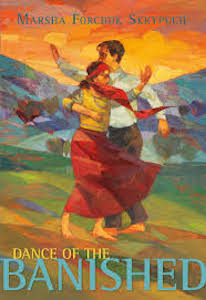


 Celeste, an insightful, curious sixth-grader living in Valparaiso, Chile, leads an idyllic life. She is the daughter of two doctors, lives in a loving multigenerational household with her Nana Delfina, a nanny, and her Abuela Frida, goes to school with good friends, and is inspired by the things she sees outside her window on Butterfly Hill. Her world is turned upside down when Valparaiso begins to feel the tremors of rule by a ruthless dictator; these tremors are referred to as “earthquakes of the soul” by Celeste’s mother. Celeste’s parents go into hiding, her friends and neighbors begin to disappear without warning, and finally she flees to Juliette Cove in Maine to stay with her Tia Graciela. There she remains for over two years awaiting the news that the dictator has been overthrown. Finally she can return to her beloved homeland. Based on the dictatorship of Augusto Pinochet in the 1970s, this novel is full of imagery and poetic language. Watercolor, ink, and digital illustrations are sprinkled sparingly throughout this compelling novel that combines the author’s personal experience with history. cc
 When Papa Rabbit doesn’t return home as expected after many seasons of working in the great carrot and lettuce fields of El Norte, Pancho sets out on a dangerous journey to find him. He packs up Papa’s favorite meal: mole, rice and beans, warm tortillas and a jug of aguamiel. A cunning coyote offers to guide Pancho on his journey in exchange for some of the sustenance he brought along. The pair travel until all the food is gone and the coyote decides he’s still hungry…for rabbit. In this allegorical tale, Tonatiuh sheds light on the hardships faced by thousands of families who seek out opportunities at better lives for their children and cross the Mexican border into the U.S. illegally. cc
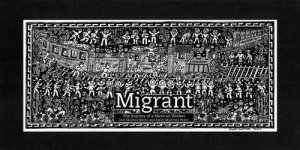 In this striking, thoughtful first-person narration, a Mexican boy tells of his journey to the United States with his family as they face many dangers. The uncertainty all illegal immigrants face arouses empathy for the real risks surrounding relevant political issues, namely, migrant journeys taken in hopes of finding work and a better life. This bilingual, codex-style book literally unfolds as the story progresses and offers a straightforward Spanish translation on the reverse side of the English version. Brilliant illustrations in charcoal blacks and greys on amate, bark paper, are reminiscent of pre-Hispanic codices. cc
 Through fictional first-person poems and brief non-fiction prose, thirteen different Latino and Latina young people in the U.S., who have diverse backgrounds and experiences are introduced to readers. The poems are reflective and heartwarming and provide specific stories. The nonfiction essays explain historical and social context, the Ladino language, the Chinese and Japanese presence in Latin America, African roots, Latino immigration to the U.S., U.S.-Cuban relations, environmentalists, and more. Bold, hand-cut illustrations, a bibliography for teachers and parents, and additional resources for young people complete this celebration of the diversity of the Latino community. mjw
 In 2002, ten-year-old Enaiatollah Akbari’s village in Afghanistan fell prey to the Taliban. His mother sent him alone to fend for himself. Dangerous border crossings, trekking on foot across snow-covered mountains in Turkey, hiding in a false bottom of a truck, and steering an inflatable dinghy to Greece are some of the seemingly insurmountable and unimaginable obstacles he faced on his five year journey to Italy, where he sought political asylum. This is an incredible story of courage, hope, and survival reconstructed from Eniat’s memories by Italian novelist Fabio Geda. A map of Eniat’s journey is included. mjw
 An American dog in Paris, ex-pat Hudson, an adventurous Norwich Terrier, discovers that it is difficult to make friends and adjust to his new environment when all the other dogs speak French, not Dog. He enrolls in a language course and learns French from Madame Vera, a French poodle. He becomes a Paris-Chien. Colorful gouache illustrations of parks, shops, cafes, and dogs bring Paris to life. French words in the illustrations are defined in a glossary. Hudson’s triumphant experience will be meaningful to any child in a new situation. mjw
 This semi-autobiographical wordless graphic novel illustrates the story of a young boy who emigrates with his family from an Asian land to New York City. Facial expressions, body language, and colors in the whimsical, abstract watercolor and digital art depict his transition and triumph in discovering his new place in a foreign landscape. An author’s note describes her journey at age four from Korea to Washington D.C. This universal tale would be useful with immigrant populations in any community. mjw
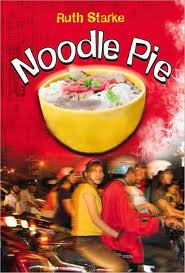 Spunky eleven-year-old Andy Nguyen, who grew up in Australia, is visiting family in Vietnam with his father, a refugee who escaped from Vietnam during the war. Insane traffic, vendors cooking on the sidewalk, street kids selling postcards to tourists, and an unfamiliar family that he has never met all contribute to Andy’s culture shock. His attitude changes as he learns more about his family and the cultural and economic differences between Vietnam and Australia. This fascinating coming-of-age story provides details about Vietnamese history and contemporary issues. Easy Vietnamese recipes and a note about street kids in Vietnam are also included. mjw
