In the pueblo of Palenque in Colombia at the turn of the 21st century, hardly anyone knows how to read or write. The young female narrator of the story is curious about the letters her older sister receives in the mail from her doctor friend. She hopes that they are love letters. Senor Velandia, the shop owner, is one of the few in the pueblo who can read. He helps the girl to read if she will help him in his shop. Slowly she learns the alphabet by writing letters on the ground with a piece of charcoal. She teaches the other children of the pueblo to read the letters with her and discover the magic of reading. The digital, richly colored, textured illustrations depict the Afro-Latine community. An author’s note explains the history of enslaved people in Central and South America, who were forbidden to read by the colonizing Spaniards. This story is woven together from the stories the author heard from various women across Colombia. mjw |
| Title: Letters In Charcoal Author: Irene Vasco Illustrator: Juan Palomino Publisher: Lantana Publishing Ltd. UK Copyright: 2023 Original Language: Spanish Translator: Lawrence Schimel Original Title: Letras al carbon Original Publisher: Editorial Juventud S.A., Spain Original Copyright: 2015 ISBN: 978-1-915244-51-2 Hardcover pages: 32 Age range: 5-9 Genre: Picture Book Book setting: Colombia Author’s ethnicity: Colombian Author’s residence: Colombia Illustrator’s ethnicity: Mexican Illustrator’s residence: Mexico Subjects: Alphabet, Central and South America, Education, Palenque, Pueblo, Reading |
Tag Archives: Language
The Wolves Of Greycoat Hall
Boris Greycoat is a friendly, sophisticated young wolf who likes to meet people and try new foods. He, his father, a polymath (an expert in many things), and his mother, who gives warm, reassuring smiles, return to their Scottish homeland to save Drommuir Castle. The castle has been in the family for generations, and now it is being threatened by a dishonest developer who wants to build villas for vacation rentals. The refined wolf family stays in the exclusive Highland Hotel, visiting turreted castles and quaint shops. They learn about other cultures and enjoy delicious cakes. Their adventure is full of surprising discoveries, one of which leads to Drommuir Castle being saved. The book includes a family tree, a table of contents, a recipe for Boris’s bannocks, a detailed map of the wolf family’s ancestral Scotland, and humorous illustrated sidebar comments on wolfish etiquette. The brilliant, amusing pen and ink drawings are magnificent. Lucinda Gifford’s author website offers fun activities to go with the book. mjw |
| Title: The Wolves Of Greycoat Hall Author: Lucinda Gifford Illustrator: Lucinda Gifford Publisher: Kane Miller, a division of EDC Publishing Copyright: 2023 Original Language: English Original Publisher: Walker Books, Australia Original Copyright: 2020 ISBN: 978-1-68464-719-4 Paperback pages: 187 Age range: 7-10 Genre: Fiction, Humor, Fantasy Book setting: Scotland Author’s ethnicity: English Author’s residence: Melbourne, Australia Illustrator’s ethnicity: English Illustrator’s residence: Melbourne, Australia Subjects: Acceptance, Architecture, Bannocks, Birds, Cakes, Castles, Dogs, Heroes, Nature preservation, Prejudices, Recipes, Vacations, Villians, Wolves |
The Cricket War
Set in 1980s Vietnam, Tho and his best friend, Lam, love cricket fighting, and soccer, but there is fear in his village that twelve-year-old boys, like them, will be conscripted into the Communist army. People are trying to leave Vietnam and move to safer countries. One day, Lam and his brother disappear. Tho’s family sells their furniture to make money to send Tho and his brother, Vu, away. Vu leaves first and a year later Tho boards a small boat to escape. He stows away on a pirate boat, crosses the South China Sea, and eventually gets to a refugee camp in Palawon in the Philippines, where he stays for six months. Finally, a Canadian elementary school teacher adopts him and he flies to his new home in Toronto. This harrowing story is based on true events in the author’s life. A map, a pronunciation guide, an afterword, and a brief recent history of Vietnam further enhance Tho’s intense account of his journey. mjw |
| Title: The Cricket War Author: Tho Pham and Sandra Mc Tavish Publisher: Kids Can Press Ltd., Toronto Copyright: 2023 Original Language: English ISBN: 978-1-5253-0655-6 Hardcover pages: 160 Age range: 9-12 Genre: Historical fiction Book setting: Vietnam; Palawan, Philippines; Toronto, Canada Author’s ethnicity: Vietnamese Author’s residence: Ottawa, Canada (Pham), Madoc, Ontario (McTavish) Subjects: Asian- Canadian authors, Boat people, Diverse characters, Hunger, Loneliness, Immigration, Pirates, Refugee camps, Refugees, Survival, Vietnam |
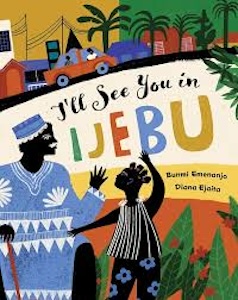
I’ll See You In Ijebu
Eight-year-old Olu, a Catholic city girl from Lagos, Nigeria, Takes a trip to the country to visit her Muslim extended family in the town of Ijebu to celebrate Eid al-Adha. She enjoys the large family gatherings with their traditional foods, love-filled happy reunions, and games with the cousins. Fascinating back matter provides information about Nigeria (with maps), children’s games and music, Nigeria’s religions, bold, bright clothing, and favorite foods. A recipe for Bunmi’s famous puff puff is included. Yoruba language words, with pronunciation guides, are smoothly integrated into the story. Author’s and illustrator’s notes offer more intriguing details. The book’s vibrant digital artwork further distinguishes the poetic storytelling. mjw |
| Title: I’ll See You In Ijebu Author: Bunmi Emenanjo Illustrator: Diana Ejaita Publisher: Barefoot Books, Inc. Copyright: 2024 Original Language: English ISBN: 978-1-64686-844-5 Paperback pages: 32 Age range: 4-10 Genre: Picture Book Book setting: Lagos, Nigeria Author’s ethnicity: Nigerian Author’s residence: Maryland, USA Illustrator’s ethnicity: Nigerian-Italian Illustrator’s residence: Berlin and Lagos Subjects: Africa, Catholic, Celebrations, Culture, Eid, Fashion, Food, Holidays, Nigeria, Multi-faith, Multi-generational, Music, Muslim, Recipes, Religions, Traditions |
On The Edge Of The World
Vera and her family live on Russia’s Kamchatka Peninsula, which seems like the edge of the world. A map of the peninsula includes geographical features and native animal life. Vera shares her most valuable things – her feather collections; her favorite book: The Lion, the Witch, and the Wardrobe; her flashlight; and her favorite food – syrniki (cottage cheese and pancakes). She introduces her mom and her grandma but says that she doesn’t have any friends. She also describes her sekretik – a secret treasure of blue glass, Legos, and forget-me-nots. Lucas and his family live in a small town on the coast of Chile, which also seems like the edge of the world. A map of his country also includes geographical features and native animal life. Lucas shares his most valuable things – ammonite fossils, his soccer ball, his flashlight, his favorite food – a hamburger, and his favorite book: The Hobbit. He introduces his mom, dad, and his grandma. He, too, has no friends. One evening, both Vera and Lucas go to the beach, and blink their flashlights into the dark using the international language of Morse Code. “What if I had a friend over there, beyond the edge of the world?” If they look hard enough, they’ll find that we’re all so very similar, and connected to each other. One set of endpapers shows the Morse Code. The other endpapers present a map depicting Russia, Chile, and the 9942 miles of Pacific Ocean between the children’s homes. The interesting illustrations were created digitally in this unique flip-formatted, two-story picture book. mjw |
| Title: On The Edge Of The World Author: Anna Desnitskaya Illustrator: Anna Desnitskaya Publisher: Eerdmans Books for Young Readers Copyright: 2023 Original Language: Russian Translator: Lena Traer ISBN: 978-0-8028-5612-8 Hardcover pages: 48 Age range: 7-11 Genre: Picture Book, flip-formatted Book setting: Russia, Chile Author’s ethnicity: Russian Author’s residence: Israel Illustrator’s ethnicity: Russian Illustrator’s residence: Israel Subjects: Asia, Beaches, Books, Central and South America, Culture, Dreams, Loneliness, Morse Code |
Dancing The Tinikling
Jojo is learning to dance between two worlds. His grandmother, who learned the tinikling in the Philippines and now lives in America, encourages him to dance to the bamboo beat. She teaches the dance at the cultural center. He finds it difficult at first, but eventually, he “spins and hops to the rhythm of his life,” jumping between the two clapping bamboo poles. Ample use of onomatopoeia with the clapping, clicking, and tapping of the bamboo poles and Tagalog words are integrated into the music of this festive story. At the end of the book, there is more information about the dance, which will inspire Americans of all cultures to appreciate the Filipino national dance. mjw |
| Title: Dancing The Tinikling Author: Bobbie Peyton Illustrator: Diobelle Cerna Publisher: Sleeping Bear Press. Ann Arbor, Michigan Copyright: 2023 Original Language: English ISBN: 978-1534111967 Hardcover pages: 32 Age range: 5-8 Genre: Picture Book Author’s ethnicity: Filipino Author’s residence: Oregon, USA Illustrator’s ethnicity: Filipino Illustrator’s residence: Philippines Subjects: Asian-American, Dance, Filipino Americans. Food, Grandmothers, Grandparents, Music, Tagalog, Tinikling |
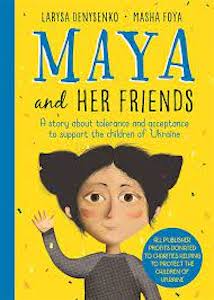
Maya And Her Friends: A Story About Tolerance And Acceptance To Support The Children of Ukraine
The author wrote this book while hiding in Kyiv near the beginning of the war in Ukraine. This is explained in an author’s note on the front end papers, which is written in both English and Ukrainian. The book is about nine-year-old Maya, who goes to school in Ukraine with her sixteen classmates. She introduces them and their teacher and tells their backgrounds and stories. We meet Hrystyna, who lives with her grandma and talks to her parents on Skype. We meet Tymko, whose mother plays the violin and her dad sings at the Opera House. Rayis is a Crimean Tatar, indigenous of Ukraine, and Petro is a Romani who has a huge family clan. Maya herself has two mums. Maya and her friends share an important message about love, respect, and what it means to be a family. The surrealistic illustrations in vivid colors enhance this interesting story about the resilience of the Ukrainian people. All proceeds from the book go to charities helping to protect the children of Ukraine. mjw |
| Title: Maya And Her Friends: A Story About Tolerance And Acceptance To Support The Children Of Ukraine Author: Larysa Denysenko Illustrator: Masha Foya Publisher: Studio Press Books. London. An imprint of Bonnier Books Copyright: 2022 Original Language: Ukrainian Translator: Burshtyna Tereshchenko Original Publisher: Vydavnytstvo Original Copyright: 2017 ISBN: 978-1-80078-414-7 Hardcover pages: 72 Age range: 7-11 Genre: Picture Book Book setting: Ukraine Author’s ethnicity: Ukrainian Author’s residence: Ukraine Illustrator’s ethnicity: Ukraine Illustrator’s residence: Ukraine Subjects: Acceptance, Difference, Multiculturalism, Schools, Tolerance, War |
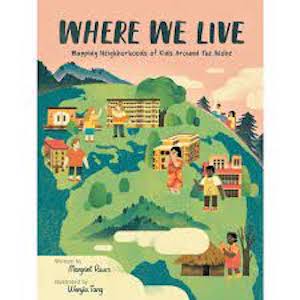
Where We Live: Mapping Neighborhoods Of Kids Around the Globe
This intriguing book is a fun look at sixteen children’s neighborhoods around the world. First, there is a helpful page with information about maps, compass roses, legends, and scale bars. Next, we meet the children and learn about their neighborhoods – where they live, go to school and play, what they eat, and sometimes their religions. Maps of each child’s neighborhood show important places, a legend, and some words from the child’s language. The places featured are the Cook Islands, Canada, the United States, Honduras, Venezuela, Antarctica, Spain, the Netherlands, Romania, Egypt, Ethiopia, Zambia, Pakistan, India, China, and Cambodia. Both small communities and big cities are included. Back matter provides activities, a glossary, an author’s note, a further-reading list, and an index. A world map with all the locations is presented on the endpapers. The digitally rendered artwork is perfect for the book. mjw |
| Title: Where We Live: Mapping Neighborhoods Of Kids Around The Globe Author: Margriet Ruurs Illustrator: Wenjia Tang Publisher: Kids Can Press Ltd., Toronto Copyright: 2022 Original Language: English ISBN: 978-1525-3013-77 Hardcover pages: 40 Age range: 7-10 Genre: Information Book, Nonfiction Book setting: Sixteen locations around the world Author’s ethnicity: Canadian Author’s residence: British Columbia Illustrator’s ethnicity: Chinese Illustrator’s residence: New York City Subjects: Communities, Customs, Explorations, Human settlements, Mapping, Maps, Neighborhoods, Traditions |
At The Drop Of A Cat
The French six-year-old narrator in this gorgeous picture book loves spending time in his Spanish grandfather’s incredible garden. The grandfather, Luis, left Spain because of the terrible war. He didn’t have a chance to be a kid, and he never learned to read and write. Together they watch birds. Luis speaks BIRD language. They also draw what they see in the magnificent garden. Luis is a great cook, too, making his house always smell good. Luis speaks in a vibrant and unique language, hence the title of the book, At the Drop of a Cat, and another phrase like “the apple of his pie.” At the end of the story, Luis gives his grandchild a guitar. Even though Luis cannot read or write, he imparts wonderful knowledge about nature and life to his grandchild. Dreamy, colorful, and rich, plant-filled pictures in watercolor and collage depict their natural world effectively. mjw |
| Title: At The Drop Of A Cat Author: Elise Fontenaille Illustrator: Violeta Lopiz Publisher: Enchanted Lion Books. New York Copyright: 2023 Original Language: French Translator: Karin Snelson and Emilie Robert Wong Original Title: Les poings sur les iles Original Publisher: Editions du Rouergue Original Copyright: 2011 ISBN: 978-1-59270-382-1 Hardcover pages: 36 Age range: 4-8 Genre: Picture Book Book setting: France Author’s ethnicity: French Author’s residence: Haute-Loire, France Illustrator’s ethnicity: Spanish Illustrator’s residence: Peru Subjects: Birds, Gardens, Grandfathers, Intergenerational, Multigenerational family life, Music |
The Barren Grounds: The Misewa Saga, Book One
Seventh grader Eli and eighth grader Morgan are Indigenous foster children in this middle-grade First Nations fantasy. The children feel disconnected from their culture and struggle to fit in at school and at their new home. They find a secret portal in an unfinished attic that leads to another reality, Aski, with frozen, barren grounds. They meet Ochek, a hunter supporting his starving community. He teaches the children traditional ways, and together they embark on a mission to save Misewa. Engaging characters, life lessons, adventure, cliffhangers, evocative descriptions, and twists make this a compelling read about the importance of taking care of the land. “The land provides everything that anybody would need. If you take only what your need, the land renews itself so that it can provide more…In exchange, because we don’t really have anything the land wants, we honor it for what it gives us.” The book is reminiscent of The Lion, The Witch, And The Wardrobe. A map of the North Country and a Swampy Cree Glossary and Pronunciation Guide are included. mjw |
| Title: The Barren Grounds Author: David A. Robertson Publisher: Puffin Canada, an imprint of Penguin Random House Canada Young Readers Copyright: 2022 Original Language: English ISBN: 978-0735-2661-24 Paperback pages: 256 Age range: 10-17 Genre: Fiction, Novel, Fantasy First Nations Book setting: Winnipeg, Manitoba Author’s ethnicity: Norway House Cree Nation Author’s residence: Winnipeg, Manitoba Awards: Honor Book in the USBBY-CBC Outstanding International Trade Books, Robertson is a two-time winner of the Governor General’s Literary Award Subjects: Cree culture, Fantasy, Folk tales, Foster homes, Indigenous stories, Myths, Chronicles of Narnia, Orphans, Traditions |
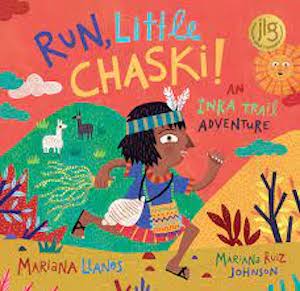
Run, Little Chaski! An Inka Trail Adventure
It is Little Chaski’s first day of delivering royal messages. He has to be strong, swift, and sharp. He gets his first mission from Queen Qoya. He is to take an important khipu (a knotted rope and thread recording system) to the King. He puts the khipu into his bag, called a ch’uspa. He runs off as fast as a puma. Along the way, he stops to help a chinchilla, a drowning allqu, and a trapped condor. When he finally gets to the temple and the King asks for the khipu, Little Chaski discovers that his ch’uspa is empty. But just then, his three grateful animal friends soar from the clouds and drop the message into Little Chaski’s hands. He is so relieved. The King tells him that his adventure was a test and since he was so kind along the way, he is now an official messenger – Big-Hearted Chaski. The colorful, bold illustrations in this engaging tale combine traditional Peruvian folk art techniques and digital media. A glossary of Quechua words, interesting information about the culture, history, and animals of the Inka, and a map of the Inka Empire at around 1525 CE further distinguish the storytelling. mjw |
| Title: Run, Little Chaski! An Inka Adventure Author: Mariana Llanos Illustrator: Mariana Ruiz Johnson Publisher: Barefoot Books. Concord, MA Copyright: 2021 Original Language: English. Also a Spanish edition. ISBN: 978-1-64686-164-4 Hardcover pages: 32 Age range: 3-7 Genre: Picture Book, Historical Fiction, Information Book Book setting: Ancient Inka (Inca) Empire, Peru Author’s ethnicity: Peruvian Author’s residence: Oklahoma Illustrator’s ethnicity: Peruvian Illustrator’s residence: Buenos Aires Argentina Subjects: Action, Ancient civilizations, Cultures, Incan Empire, Kindness, Multicultural, Peru, Peruvian tales, South America |
Pablo Neruda Book of Questions
This bilingual Spanish-English edition, the first illustrated selection of 70 questions from Pablo Neruda’s original poem (320 questions), The Book of Questions, is a glorious introduction to Neruda’s works for young children. “Why don’t they teach helicopters how to draw honey from the sun? How did the abandoned bicycle find its freedom? Does the earth chirp like a cricket in the symphony of the skies?” These are a few of the unanswerable imaginative questions posed in the text. The book is large and includes fold-out pages. Blues, reds, and yellows against black or white backgrounds created by pencil and ink have a folk art feel. This is a gorgeous book. mjw |
| Title: Pablo Neruda Book Of Questions – Bilingual Spanish-English Author: Pablo Neruda (1904-1973) Illustrator: Paloma Valdivia Publisher: Enchanted Lion Books Copyright: 2022 Original Language: Spanish Translator: Sara Lissa Paulson Original Title: Libro de las Preguntas Original Copyright: 1974 ISBN: 978-1-59270-322-7 Hardcover pages: 80 Age range: 5 up Genre: Picture Book, Poetry Author’s ethnicity: Chilean Illustrator’s ethnicity: Chilean Illustrator’s residence: Santiago, Chile Awards: Nobel Prize in Literature 1971 Subjects: Bilingual, Chilean, Hispanic, Imagination, Poetry, Questions, Spanish |

In the pueblo of Palenque in Colombia at the turn of the 21st century, hardly anyone knows how to read or write. The young female narrator of the story is curious about the letters her older sister receives in the mail from her doctor friend. She hopes that they are love letters. Senor Velandia, the shop owner, is one of the few in the pueblo who can read. He helps the girl to read if she will help him in his shop. Slowly she learns the alphabet by writing letters on the ground with a piece of charcoal. She teaches the other children of the pueblo to read the letters with her and discover the magic of reading. The digital, richly colored, textured illustrations depict the Afro-Latine community. An author’s note explains the history of enslaved people in Central and South America, who were forbidden to read by the colonizing Spaniards. This story is woven together from the stories the author heard from various women across Colombia. mjw
Set in 1980s Vietnam, Tho and his best friend, Lam, love cricket fighting, and soccer, but there is fear in his village that twelve-year-old boys, like them, will be conscripted into the Communist army. People are trying to leave Vietnam and move to safer countries. One day, Lam and his brother disappear. Tho’s family sells their furniture to make money to send Tho and his brother, Vu, away. Vu leaves first and a year later Tho boards a small boat to escape. He stows away on a pirate boat, crosses the South China Sea, and eventually gets to a refugee camp in Palawon in the Philippines, where he stays for six months. Finally, a Canadian elementary school teacher adopts him and he flies to his new home in Toronto. This harrowing story is based on true events in the author’s life. A map, a pronunciation guide, an afterword, and a brief recent history of Vietnam further enhance Tho’s intense account of his journey. 
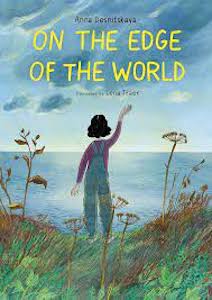
Vera and her family live on Russia’s Kamchatka Peninsula, which seems like the edge of the world. A map of the peninsula includes geographical features and native animal life. Vera shares her most valuable things – her feather collections; her favorite book: The Lion, the Witch, and the Wardrobe; her flashlight; and her favorite food – syrniki (cottage cheese and pancakes). She introduces her mom and her grandma but says that she doesn’t have any friends. She also describes her sekretik – a secret treasure of blue glass, Legos, and forget-me-nots. Lucas and his family live in a small town on the coast of Chile, which also seems like the edge of the world. A map of his country also includes geographical features and native animal life. Lucas shares his most valuable things – ammonite fossils, his soccer ball, his flashlight, his favorite food – a hamburger, and his favorite book: The Hobbit. He introduces his mom, dad, and his grandma. He, too, has no friends. One evening, both Vera and Lucas go to the beach, and blink their flashlights into the dark using the international language of Morse Code. “What if I had a friend over there, beyond the edge of the world?” If they look hard enough, they’ll find that we’re all so very similar, and connected to each other. One set of endpapers shows the Morse Code. The other endpapers present a map depicting Russia, Chile, and the 9942 miles of Pacific Ocean between the children’s homes. The interesting illustrations were created digitally in this unique flip-formatted, two-story picture book
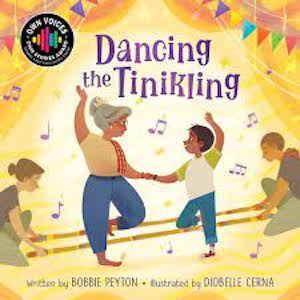
Jojo is learning to dance between two worlds. His grandmother, who learned the tinikling in the Philippines and now lives in America, encourages him to dance to the bamboo beat. She teaches the dance at the cultural center. He finds it difficult at first, but eventually, he “spins and hops to the rhythm of his life,” jumping between the two clapping bamboo poles. Ample use of onomatopoeia with the clapping, clicking, and tapping of the bamboo poles and Tagalog words are integrated into the music of this festive story. At the end of the book, there is more information about the dance, which will inspire Americans of all cultures to appreciate the Filipino national dance. mjw
The French six-year-old narrator in this gorgeous picture book loves spending time in his Spanish grandfather’s incredible garden. The grandfather, Luis, left Spain because of the terrible war. He didn’t have a chance to be a kid, and he never learned to read and write. Together they watch birds. Luis speaks BIRD language. They also draw what they see in the magnificent garden. Luis is a great cook, too, making his house always smell good. Luis speaks in a vibrant and unique language, hence the title of the book, At the Drop of a Cat, and another phrase like “the apple of his pie.” At the end of the story, Luis gives his grandchild a guitar. Even though Luis cannot read or write, he imparts wonderful knowledge about nature and life to his grandchild. Dreamy, colorful, and rich, plant-filled pictures in watercolor and collage depict their natural world effectively
This bilingual Spanish-English edition, the first illustrated selection of 70 questions from Pablo Neruda’s original poem (320 questions), The Book of Questions, is a glorious introduction to Neruda’s works for young children. “Why don’t they teach helicopters how to draw honey from the sun? How did the abandoned bicycle find its freedom? Does the earth chirp like a cricket in the symphony of the skies?” These are a few of the unanswerable imaginative questions posed in the text. The book is large and includes fold-out pages. Blues, reds, and yellows against black or white backgrounds created by pencil and ink have a folk art feel. This is a gorgeous book. mjw