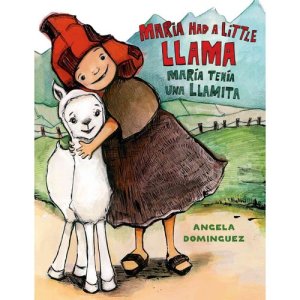
 “Mary Had A Little Lamb,” the classic rhyme, has been transformed in this bilingual version which takes place in rural Peru. Each straightforward English verse is accompanied with the Spanish translation directly below, making this a perfect read-aloud. Readers are transported to Peru as they read the rhythmically flowing text and view warm gouache and ink illustrations. A wordless picture spread allows students to become authors, making up their own stories. Distinctive Peruvian features such as Andean dress, culture, and landscape are depicted. cc “Mary Had A Little Lamb,” the classic rhyme, has been transformed in this bilingual version which takes place in rural Peru. Each straightforward English verse is accompanied with the Spanish translation directly below, making this a perfect read-aloud. Readers are transported to Peru as they read the rhythmically flowing text and view warm gouache and ink illustrations. A wordless picture spread allows students to become authors, making up their own stories. Distinctive Peruvian features such as Andean dress, culture, and landscape are depicted. cc |
| Title: Maria Had A Little Llama (Maria Tenia Una Llamita) Author: Angela Dominguez Illustrator: Angela Dominguez Publisher: Henry Holt and Company, LLC Copyright: 2013 Original language: English ISBN: 978-0805093339 Hardcover pages: 28 Age range: 3-7 Genre: Picture book Book setting: Peru Author’s ethnicity: Mexican Author’s residence: United States Awards: 2014 Pura Belpre Award (Illustrator Honor) Subjects: Animals, Bilingual, Llamas, Peru, Peruvian culture, South America, Spanish language, Stories in rhyme |
Maria Had A Little Llama (Maria Tenia Una Llamita)
Leave a reply
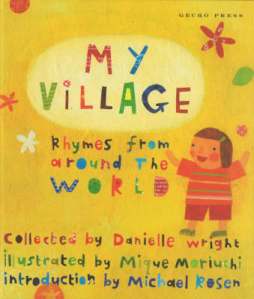 Twenty-two nursery rhymes from around the globe are presented in English, the original language, and the original alphabet when appropriate. New Zealand, China, Australia, Norway, Ireland, Tonga, Jamaica, Japan, Zimbabwe, Fiji, Indonesia, Denmark, Iran, Germany, Samoa, Switzerland, Russia, Brazil, France, Holland, Iceland, and India are illustrated in bright collage and mixed-media artwork. Children’s Laureate Michael Rosen introduces the collection. Source notes are provided, but the name of the original language is not always given. mjw
 Through fictional first-person poems and brief non-fiction prose, thirteen different Latino and Latina young people in the U.S., who have diverse backgrounds and experiences are introduced to readers. The poems are reflective and heartwarming and provide specific stories. The nonfiction essays explain historical and social context, the Ladino language, the Chinese and Japanese presence in Latin America, African roots, Latino immigration to the U.S., U.S.-Cuban relations, environmentalists, and more. Bold, hand-cut illustrations, a bibliography for teachers and parents, and additional resources for young people complete this celebration of the diversity of the Latino community. mjw
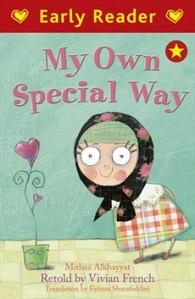 Hamda feels left out. She wants to make necklaces, go shopping, and bake cakes like her older sisters do. She has also made up her mind that she wants to wear the veil. She chooses four different scarves and unsuccessfully tries four different ways to wear them. She finally finds her own special way to prove she’s a big girl. Told in five short chapters and illustrated with bold, colorful patterns, this entertaining story focuses on the Muslim experience of wearing the veil mjw
 This lively rhyme with bright, avant-garde illustrations tells of a lady who gets on the train with a suitcase, a hatbox, a couch, a painting, a package, a pouch, and a cute little pooch. During the journey, an enormous shaggy dog is substituted for the pooch. When the astonished woman claims her baggage, she is told that her dog grew up on the trip. This is a reproduction in size and layout of the Russian book, which was first published in 1926 to mold the minds of the children of the revolution. The original Russian text is included. mjw
 Like most Muslim girls between the ages of nine and 15 in Mauritania, Lalla wants to wear a malafa, the veil that covers women’s heads and clothes in public. She learns from her mama, her older sister, market ladies, and her grandmother that the malafa is more than beauty, mystery, tradition, and belonging. It is for faith. The second-person narrative and cut-paper collage illustrations explain potentially unfamiliar customs and observances of faith. An author’s note and a glossary of Hassaniya words is included. mjw
 A young girl who lives in Pienza, Italy, tells the history of pizza. She also describes the customs in her community, like her midday meal and Giovanni’s, where pizza is cooked the old-fashioned way in a wood-fired brick oven. She learns at the library that ancient Greeks ate flatbreads, that a favorite pizza was named after Queen Margherita of Italy, circa 1889, and that the first pizzeria opened in New York City in 1905. The English text appears with an Italian translation on each page. Also included are a pronunciation guide, a two-page history of pizza, and a recipe. mjw
 An American dog in Paris, ex-pat Hudson, an adventurous Norwich Terrier, discovers that it is difficult to make friends and adjust to his new environment when all the other dogs speak French, not Dog. He enrolls in a language course and learns French from Madame Vera, a French poodle. He becomes a Paris-Chien. Colorful gouache illustrations of parks, shops, cafes, and dogs bring Paris to life. French words in the illustrations are defined in a glossary. Hudson’s triumphant experience will be meaningful to any child in a new situation. mjw