
 This lively rhyme with bright, avant-garde illustrations tells of a lady who gets on the train with a suitcase, a hatbox, a couch, a painting, a package, a pouch, and a cute little pooch. During the journey, an enormous shaggy dog is substituted for the pooch. When the astonished woman claims her baggage, she is told that her dog grew up on the trip. This is a reproduction in size and layout of the Russian book, which was first published in 1926 to mold the minds of the children of the revolution. The original Russian text is included. mjw This lively rhyme with bright, avant-garde illustrations tells of a lady who gets on the train with a suitcase, a hatbox, a couch, a painting, a package, a pouch, and a cute little pooch. During the journey, an enormous shaggy dog is substituted for the pooch. When the astonished woman claims her baggage, she is told that her dog grew up on the trip. This is a reproduction in size and layout of the Russian book, which was first published in 1926 to mold the minds of the children of the revolution. The original Russian text is included. mjw |
| Title: Baggage Author: Samuil Marshak Illustrator: Vladimir Lebedev Publisher: The Museum of Modern Art Copyright: 2012 Original language: Russian Translator: Jamey Gambrell Original title: Bagazh Original publisher: Raduga Original copyright: 1926 ISBN: 978-0-87070-842-8 Hardcover pages: 12 Age range: 6 up Genre: Picture book Book setting: Russia Author’s residence: Russia Illustrator’s residence: Russia Subjects: Dogs, Eastern Europe, Europe, Luggage, Railroad travel |
Baggage
Leave a reply
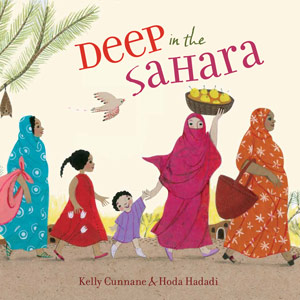 Like most Muslim girls between the ages of nine and 15 in Mauritania, Lalla wants to wear a malafa, the veil that covers women’s heads and clothes in public. She learns from her mama, her older sister, market ladies, and her grandmother that the malafa is more than beauty, mystery, tradition, and belonging. It is for faith. The second-person narrative and cut-paper collage illustrations explain potentially unfamiliar customs and observances of faith. An author’s note and a glossary of Hassaniya words is included. mjw
 A young girl who lives in Pienza, Italy, tells the history of pizza. She also describes the customs in her community, like her midday meal and Giovanni’s, where pizza is cooked the old-fashioned way in a wood-fired brick oven. She learns at the library that ancient Greeks ate flatbreads, that a favorite pizza was named after Queen Margherita of Italy, circa 1889, and that the first pizzeria opened in New York City in 1905. The English text appears with an Italian translation on each page. Also included are a pronunciation guide, a two-page history of pizza, and a recipe. mjw
 An American dog in Paris, ex-pat Hudson, an adventurous Norwich Terrier, discovers that it is difficult to make friends and adjust to his new environment when all the other dogs speak French, not Dog. He enrolls in a language course and learns French from Madame Vera, a French poodle. He becomes a Paris-Chien. Colorful gouache illustrations of parks, shops, cafes, and dogs bring Paris to life. French words in the illustrations are defined in a glossary. Hudson’s triumphant experience will be meaningful to any child in a new situation. mjw
 OmniLibros