
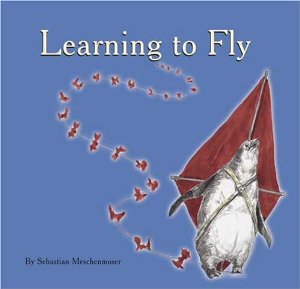
 The deadpan, bearded storyteller declares, “Last winter, I found a penguin.” The wayward penguin knew how to fly until some other birds told him that he couldn’t fly. That’s when he crashed. The man takes the penguin home, determined to help the little penguin out. They eat fish sticks together, test the penguin’s body stress level in a clothes dryer, and try all kinds of schemes to get him airborne. Fireworks, ites, and glued-on feathers don’t do the trick. Finally, when he sees a group of penguins flying above, he stretches his wings and takes off. And he “flew pretty well…for a penguin.” The straightforward tone and black-and-white pencil sketches with splashes of color will delight children and adults. This contemporary fable is about believing in yourself and dreaming and creative problem solving. mjw The deadpan, bearded storyteller declares, “Last winter, I found a penguin.” The wayward penguin knew how to fly until some other birds told him that he couldn’t fly. That’s when he crashed. The man takes the penguin home, determined to help the little penguin out. They eat fish sticks together, test the penguin’s body stress level in a clothes dryer, and try all kinds of schemes to get him airborne. Fireworks, ites, and glued-on feathers don’t do the trick. Finally, when he sees a group of penguins flying above, he stretches his wings and takes off. And he “flew pretty well…for a penguin.” The straightforward tone and black-and-white pencil sketches with splashes of color will delight children and adults. This contemporary fable is about believing in yourself and dreaming and creative problem solving. mjw |
| Title: Learning To Fly Author: Sebastian Meschenmoser Illustrator: Sebastian Meschenmoser Publisher: Kane Miller Book Publishers Copyright: 2011 Original language: German Translator: Margarita Santos Cuesta Original title: Fliegen lernen Original publisher: Esslinger Verlag J.F. Schreiber Original copyright: 2005 ISBN: 978-1-1935279-99-0 Hardcover pages: 56 Age range: 4 up Genre: Picture book Author’s residence: Germany Awards: 2008 Bank Street College Best Children’s Books of the Year Subjects: Germany, Self-esteem, Self-respect, Penguins, Persistence, Western Europe |
Learning To Fly
Leave a reply
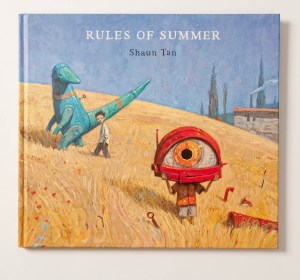 In this fantastical picture book, the big brother sets the rules. The rules and consequences are arbitrary and unpredictable. “Never leave a red sock on the clothesline” is followed by an image of a gigantic red rabbit glaring at the terrified boys. “Never be late for a parade” leads to a procession of weird mechanical toys. And finally, “Always know the way home” shows the two boys safely sitting on the couch watching TV. The living room walls are covered with images of all the out-of-this-world creatures they encountered in the book. Lavish, thick oil paintings epics the mysterious world of the two boys’ imagination. An app of the story, published by Wheelbarrow- Australia, draws readers into Tan’s surreal landscape. mjw
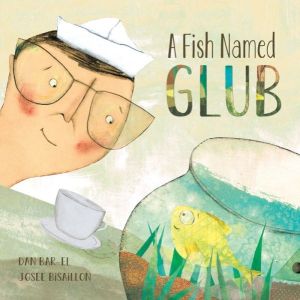 As Glub the fish swims around in his glass bowl on the counter, he ponders big questions in life: “Who am I?” “What do I need?” “What is a home?” He finds the answers he seeks by listening to the lively, colorful characters who eat at Foster G. Williker’s diner. Through Glub, these characters, including Foster, find answers of their own as they look into the bowl while Glub swims around painting pictures in bubbles of their dreams and long forgotten desires. This power to show people their dreams comes in handy as Glub is able to help Foster achieve his desperate desires of adventure and change . Rich illustrations accompany lively, lyrical dialogue that alternates between humans and Glub’s personal thoughts. cc
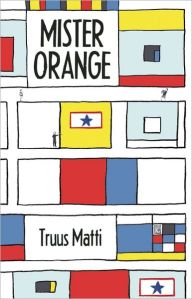 In 1943, when his older brother joins the army, 12 year-old Linus Muller, takes over the delivery job in his family’s grocery store in Manhattan. He befriends an eccentric customer, Mr Orange, who always orders a crate of oranges and is based on the Dutch painter, Piet Mondrian. They discuss the war, music, art, comic books and superheroes, and imagination. This is a first-rate historical novel about the artist and Linus Muller’s changing perception of the war. An afterword offers facts about Mondrian’s work and years in New York City. Further Resources for reading, watching on the Internet, and viewing Mondrian’s art in museums are also included. mjw
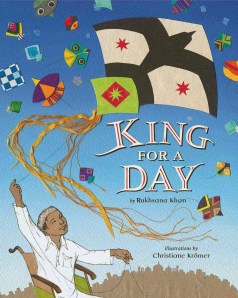 Malik, a boy in a wheelchair, does batter with other kites in the Basant festival from his rooftop in Lahore, Pakistan. With Falcon, his specially built-for-speed kite, he captures many kites including two flown by the bully next door. His good natured spirit shines through when the bully takes a young girl’s kite and Malik, as king for the day, helps the girl. Cut paper, yarn, Pakistani fabric, ribbon and pencil sketch collage illustrations from varying perspectives provide a kite’s eye view of the festival. A pronunciation guide and an afterword about the celebration of Basant are included in the book, and a teacher’s guide is available on the
 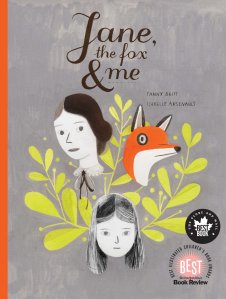 Adolescent Helene has been ostracized by girls who had once been her friends. They scribble insults on the school walls and snicker about her on the bus. Her escape is Charlotte Bronte’s Jane Eyre. When she goes on a camping trip with her class, she discovers an amazing red fox and a new friend, Geraldine. The mixed-media illustrations alternate between Helene’s sad, black-and-white world and Jane Eyre’s bold colorful English countryside. Helene’s world changes as she learns that she is worthy of friendship. mjw
 Geoffrey the gangly giraffe has trouble making friends due to his clumsiness. He slips, stumbles, and splashes his way through the African Savannah. He has to stoop to meet the meerkats, elephants, and other animals who are all much shorter than he is. “Oh dear, Geoffrey,” is repeated various times. He is fed up. Then, some young monkeys ask for help getting to the top of the tree where he also befriends a group of birds who have been following him all along. Geoffrey realizes that he can make friends by standing tall and being himself. The author uses onomatopoetic language and a hint of humor to narrate this story. Gouache and collage illustrations help bring Geoffrey’s adorable awkwardness to life. jjr
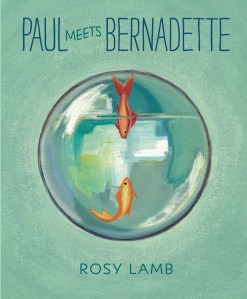 Paul the goldfish swims in circles every day until Bernadette literally drops into his fish bowl. She shows Paul a whole new world beyond the curved glass of his bowl. A banana-shaped boat. A blue teapot mother elephant. A green alarm clock cactus. And a milk carton, orange juice bottle Milwaukee skyline. As Paul examines the intriguing world outside, he becomes equally captured by his new companion. Vibrant oil paintings bring this story about love, friendship, and an active imagination to life. mjw
 Lottie keeps her found treasures and secrets locked in a battered brown leather suitcase that was a gift from her grandfather. Sometimes she wishes there was someone with whom she could share her secrets. But the other children find Lottie odd and her suitcase ugly. Leon, the boy next door, sits alone every day in his back garden playing his tuba to Mozart, his cat. One day, the cat disappears and the music stops. These two different children become friends. Lovely drawings with old photos and collage support this delicate story of acceptance and understanding. mjw
 Young Themba lives in poverty with his mother and younger sister in rural South Africa and dreams of becoming a famous soccer player. This is a rags to riches story about hope, triumph, and family love, but it is also an eye-opening story about the secretiveness and shame surrounding HIV/AIDS. The novel was made into an international movie which won the UNICEF Child Rights Award in 2010. mjw
 In this cautionary ecological parable, best friends Hulda and Brimir, live on a beautiful, tranquil blue planet that is inhabited by children who never grow old. One day, a grown-up, Gleesome Goodday, “Dream Come True Maker and joy bringer,” crashes his spaceship on the beach. He sprinkles all the children with sun-activated fly powder, nails the sun in the sky so it can always be play time, and charges them a bit of their youth. When the children fly to the other side of the planet and see sickly, pale, dying children, they realize the Goodday is not all that he seems. mjw
 OmniLibros