
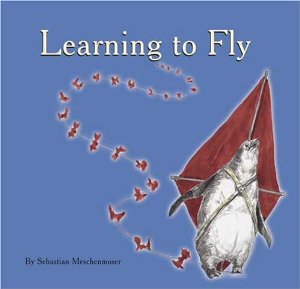
 The deadpan, bearded storyteller declares, “Last winter, I found a penguin.” The wayward penguin knew how to fly until some other birds told him that he couldn’t fly. That’s when he crashed. The man takes the penguin home, determined to help the little penguin out. They eat fish sticks together, test the penguin’s body stress level in a clothes dryer, and try all kinds of schemes to get him airborne. Fireworks, ites, and glued-on feathers don’t do the trick. Finally, when he sees a group of penguins flying above, he stretches his wings and takes off. And he “flew pretty well…for a penguin.” The straightforward tone and black-and-white pencil sketches with splashes of color will delight children and adults. This contemporary fable is about believing in yourself and dreaming and creative problem solving. mjw The deadpan, bearded storyteller declares, “Last winter, I found a penguin.” The wayward penguin knew how to fly until some other birds told him that he couldn’t fly. That’s when he crashed. The man takes the penguin home, determined to help the little penguin out. They eat fish sticks together, test the penguin’s body stress level in a clothes dryer, and try all kinds of schemes to get him airborne. Fireworks, ites, and glued-on feathers don’t do the trick. Finally, when he sees a group of penguins flying above, he stretches his wings and takes off. And he “flew pretty well…for a penguin.” The straightforward tone and black-and-white pencil sketches with splashes of color will delight children and adults. This contemporary fable is about believing in yourself and dreaming and creative problem solving. mjw |
| Title: Learning To Fly Author: Sebastian Meschenmoser Illustrator: Sebastian Meschenmoser Publisher: Kane Miller Book Publishers Copyright: 2011 Original language: German Translator: Margarita Santos Cuesta Original title: Fliegen lernen Original publisher: Esslinger Verlag J.F. Schreiber Original copyright: 2005 ISBN: 978-1-1935279-99-0 Hardcover pages: 56 Age range: 4 up Genre: Picture book Author’s residence: Germany Awards: 2008 Bank Street College Best Children’s Books of the Year Subjects: Germany, Self-esteem, Self-respect, Penguins, Persistence, Western Europe |
Learning To Fly
Leave a reply
 This 1932 masterpiece is a picture of life as it once was in Norway. Ola is a young boy who travels from one end of Norway to another. He meets new friends, attends a traditional bridal feast, gets caught in a tree, and learns folklore from fishermen before he returns home. Charming stone lithographs illustrate the fantastic Northern landscape. mjw
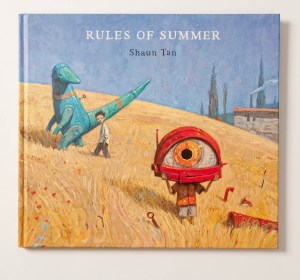 In this fantastical picture book, the big brother sets the rules. The rules and consequences are arbitrary and unpredictable. “Never leave a red sock on the clothesline” is followed by an image of a gigantic red rabbit glaring at the terrified boys. “Never be late for a parade” leads to a procession of weird mechanical toys. And finally, “Always know the way home” shows the two boys safely sitting on the couch watching TV. The living room walls are covered with images of all the out-of-this-world creatures they encountered in the book. Lavish, thick oil paintings epics the mysterious world of the two boys’ imagination. An app of the story, published by Wheelbarrow- Australia, draws readers into Tan’s surreal landscape. mjw
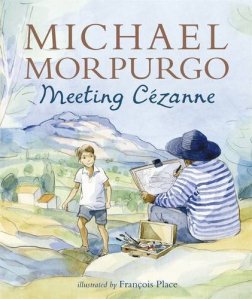 Ten-year-old Yannick leaves Paris to stay with his aunt and uncle at their inn in Provence. He is excited to go because Provence is where Cezanne, “the greatest painter in the world,” painted his picture. He works in the inn, setting tables, clearing tables, filling carafes of water, and cutting bread. Uncle Bruno teaches him to cook and make chocolate mousse and creme brulee. When a famous painter visits the inn and Yannick accidentally throws the drawing the painter scribbled on the paper tablecloth into the fireplace, he follows him back to his chateau to ask for another drawing. Yannick thinks the artist is Cezanne, but the artist signs another name, Picasso. Soft watercolor illustrations decorate the charming description of the culture of 1960s Provence. mjw
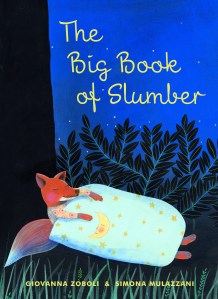 In this quiet, rhyming couplet bedtime story, we meet countless cozy animals settling in their beds. Camels snore under quilts in their bunk beds. Lion sleeps on his white lace pillow. Snake dreams in his elongated twin bed. Monkey in his striped pajamas is tucked in with a banana. Paint and collage illustrations are restful and have a folk like quality. mjw
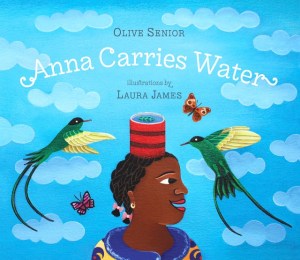 Anna, the youngest child in her large Jamaican family, wants to fetch water and carry it on her head like her brothers and sisters do. But, she cannot even balance an empty coffee can on her head. Anna is determined and she finally does succeed when the cows in Mister Johnson’s field frighten her and she runs home with her full coffee can on her head. She doesn’t spill a drop. The Jamaican landscape, a Jamaican flag, dasheen leaves, and Anna’s family are presented in interesting, bold acrylic paintings in tropical colors. mjw
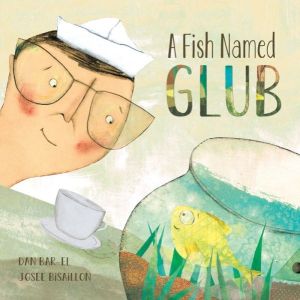 As Glub the fish swims around in his glass bowl on the counter, he ponders big questions in life: “Who am I?” “What do I need?” “What is a home?” He finds the answers he seeks by listening to the lively, colorful characters who eat at Foster G. Williker’s diner. Through Glub, these characters, including Foster, find answers of their own as they look into the bowl while Glub swims around painting pictures in bubbles of their dreams and long forgotten desires. This power to show people their dreams comes in handy as Glub is able to help Foster achieve his desperate desires of adventure and change . Rich illustrations accompany lively, lyrical dialogue that alternates between humans and Glub’s personal thoughts. cc
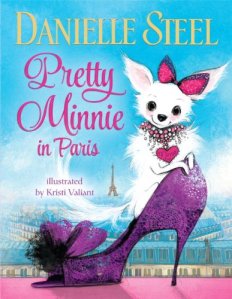 Minnie, a fashionable teacup-sized Chihuahua, is a little dog with big style. She does everything with her owner, Francoise. They like to go to the top of the Eiffel Tower, go to their favorite bistro for lunch, and rice their bicycle in the Jardin du Luxembourg. One day, Minnie is invited to the big Paris fashion show but she gets separated from her owner and lost in the chaos of a busy, noisy runway show. The pampered pup becomes the star of the show when a model wearing a wedding dress picks her up and struts down the runway. The model and Minnie meet the flash of a photographer’s camera at the end of the runway and the photo is published in the newspaper the next day. A gorgeous Paris backdrop and adorable outfits make this beautifully illustrated tale perfect for young girls. cc
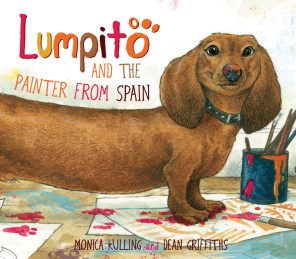 Lump and Big Dog do not get along. When Lump gets the opportunity to get a break from Big Dog, he eagerly tags along on a trip to France with his master David. At the villa in France, Lump meets the famous painter, Pablo Picasso, and new playmates, Yan the dog and Esmeralda the goat. Picasso is positively enchanted with Lump, whom he calls Lumpito, the two become soulmates, and Lumpito refuses to leave. This charmingly illustrated book is based on the true story of Picasso’s love for a dachshund named Lumptio who became the subject of countless paintings and drawings. cc
 On Hal’s tenth birthday, he receives a dog that he calls Fleck from Easy Pets. He knows they will be friends for life. But no one tells him that Easy Pets is a rent-a-pet agency and that Fleck has to be returned. Hal and his friend Pippa run away to his grandparents with a pack of escapee dogs from Easy Pets. On their cross country adventures, they meet up with a circus, a detective, greedy adults, and wonderful friends. This light, fun story about Hal and his dog, loyalty, and determination has a happy ending. All of the dogs find the right owners to belong to. mjw
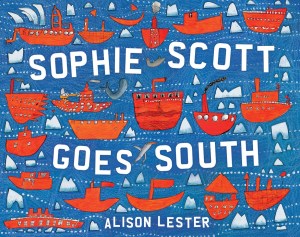 Nine-year-old Sophie accompanies her dad, the captain of an ice breaker, on a month-long journey to Mawson Station in Antarctica. Her diary is packed with facts about the South Pole’s early explorers, Antarctic animals, and life in an Antarctic research station. Endpapers with detailed maps; photographs of icebergs and sunsets; diagrams of the ship; and student paintings from Kids Antarctic Art, a traveling exhibition of children’s interpretations of the continent, reveal the wonder of Antarctica through a little girls eyes. A glossary is included. This book is based on the author’s own six-week excursion on the Aurora Australis. mjw
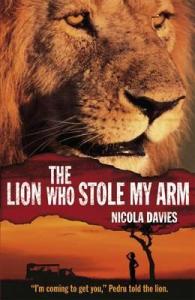 Young Pedru, who lives in the village of Madune in Mozambique, loses his arm when a lion attacks him. As he recovers, he strengthens his drawing talent and his desire for revenge. He accompanies his father on a lion hunt and mistakenly kills a lion wearing a tracking collar. This leads him to a conservation research center where he learns to look at the relationship between lions and farmers in a different way. Black and white illustrations and simple language convey Pedru’s story. Helpful footnotes explain African flora and fauna. An afterward, “Living with Lions,” contains factual notes and information about the Niassa Carnivore Project of Mozambique. This book is the first in a series of books which combine real animals and conservation in fictional stories. mjw
 OmniLibros