
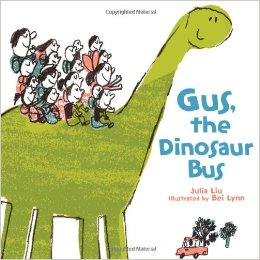
 Gus, the pea-green supersaurus takes children to school as if he is a bus. No one misses school. Bus stops aren’t necessary. And Gus is fuel efficient. But there are problems. He leaves dino-sized potholes, gets tangled in telephone lines, and knocks down traffic lights. Everyone is sad when the principal has to pull Gus off the road, until Gus becomes the school’s new playground, complete with a swing and slide. Watercolor and pencil drawings are wacky and resemble child-created, crayon-colored artwork. mjw Gus, the pea-green supersaurus takes children to school as if he is a bus. No one misses school. Bus stops aren’t necessary. And Gus is fuel efficient. But there are problems. He leaves dino-sized potholes, gets tangled in telephone lines, and knocks down traffic lights. Everyone is sad when the principal has to pull Gus off the road, until Gus becomes the school’s new playground, complete with a swing and slide. Watercolor and pencil drawings are wacky and resemble child-created, crayon-colored artwork. mjw |
| Title: Gus, The Dinosaur Bus Author: Julia Liu Illustrator: Bei Lynn Publisher: Houghton Mifflin Harcourt Publishing Company Copyright: 2013 Original Language: English Translator: Jamie White Original title: Riding Dinosaurs to School Original publisher: Aichi Books Co., Ltd., Taiwan Original copyright: 2012 ISBN: 978-0547905730 Hardcover pages: 32 Age range: 4-8 Genre: Picture book Author’s residence: Taiwan Illustrator’s residence: Taiwan Subjects: Asia, Dinosaurs, Eastern Asia, School buses, Traffic congestion |
Gus, The Dinosaur Bus
Leave a reply
 TIn 1968, in the coal mining town of Springhill, Nova Scotia, nine-year-old Jenny dreams of being a famous singer, but she suffers from stage fright and has become the target of bullies at school. She makes friends with Melody, a proud Mi’kmaq girl who has moved from a residential school. The girls bond. They both love books, nature, and music. The powerful harmony they develop helps them face challenges of peer cruelty, racism, and grief. The time and place of socially evolving Canada are captured perfectly in the first-person narration. mjw
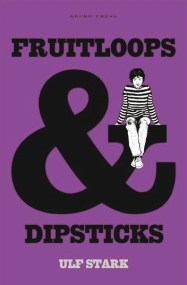 When her new teacher mistakes twelve-year-old Simone for a boy, the excitement and complications of her double life begin. Quirky and eccentric characters; amusing episodes; and themes encompassing teenage identity, sexuality, gender, intergenerational friendships, and death make this an interesting and entertaining story. Simone’s world of fruitloops and dipsticks includes an impulsive and artistic mother, ducks in the classroom, lost dogs, and kooky friends. First published in Sweden in 1984, this beautifully written first person narration is a product of its time with a real Scandinavian flavor. mjw
 OmniLibros