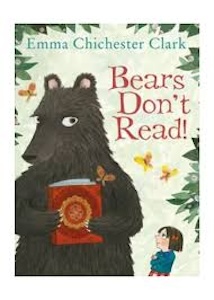
This lovely sequel to Bear’s Don’t Read! (also on OmniLibros.com) features George, the bear who lives with a little girl called Clementine and her mother, who taught him to read. One day, he decides to take his library book back to the library by himself. Along the way, he sparks panic all over town. People are afraid, shops close, and the library closes, too. Poor George lands in a fountain, the diverse crowd laughs at him, and his library book gets ruined. Just then, Clementine runs from the crowd. When George sees her, he bursts into tears. Someone in the crowd whispers, “Bears don’t cry, do they?” Clementine explains that they have hurt his feelings. A lady from the crowd gives him a hankie; they are all genuinely sorry. The librarian brings George a new library book, which he then reads to the crowd. Colorful, detailed, lively illustrations enhance this heart-warming story about friendship and kindness. mjw This lovely sequel to Bear’s Don’t Read! (also on OmniLibros.com) features George, the bear who lives with a little girl called Clementine and her mother, who taught him to read. One day, he decides to take his library book back to the library by himself. Along the way, he sparks panic all over town. People are afraid, shops close, and the library closes, too. Poor George lands in a fountain, the diverse crowd laughs at him, and his library book gets ruined. Just then, Clementine runs from the crowd. When George sees her, he bursts into tears. Someone in the crowd whispers, “Bears don’t cry, do they?” Clementine explains that they have hurt his feelings. A lady from the crowd gives him a hankie; they are all genuinely sorry. The librarian brings George a new library book, which he then reads to the crowd. Colorful, detailed, lively illustrations enhance this heart-warming story about friendship and kindness. mjw |
| Title: Bears Don’t Cry! Author: Emma Chichester Clark Illustrator: Emma Chichester Clark Publisher: Kane Miller, a division of EDC Publishing Copyright: 2023 Original Language: English Original Publisher: Harper Collins Children’s Books Original Copyright: 2022 ISBN: 978-1-68464-514-5 Hardcover pages: 32 Age range: 4-8 Genre: Picture Book Author’s ethnicity: British Author’s residence: London Illustrator’s ethnicity: British Illustrator’s residence: London Subjects: Bears, Books, Compassion, Friendship, Kindness, Reading, Understanding |
Bears Don’t Cry!
Leave a reply

 Narrated by a young refugee, this beautiful and realistic picture book tells about having to leave home and the healing power of hope. The girl and her mother used to live in an apartment with a star-shaped lamp in their window. In their new country, everything is different – the language, their apartment, and the food. One day, the mother brings home art supplies so that they can make a cardboard star just like the one they had back home. That helps to make their new place feel a little more like home. The penultimate page shows the girl with a new friend, both carrying their musical instruments. The mostly blue and yellow illustrations were created with hand drawn contours and Photoshop. An author’s note explains that the book was inspired by Desnitskaya’s experience leaving Russia after the start of the Ukraine War. It is the author’s hope that his book can help children from different countries who have lost their homes to start loving the place where they were forced to be.
 Rumi (1207-1273) was a poet, an Islamic scholar, and a Sufi mystic. He wrote in Persian/Farsi. He is one of the best-known and most widely-read poets in the world. As a child, he was enchanted by birds and books. He loved to play and dance in the garden. He had many questions, which his father answered patiently. When Rumi was older, he met Attar the great Persian poet. He read Attar’s epic poem called “The Conference of Birds” and searched for its deeper meaning. Years, later, Rumi moved to Turkey, where he met Shams, who was a great Persian spiritual teacher. Shams was a sun shining in Rumi’s heart and mind. Later, Rumi wrote his poetic masterpiece, “The Masnavi.” He also loved telling stories to children. “Be a friend to everyone” was his great message. This touching picture book biography radiates Rumi’s wisdom and warmth. Strong colors and ornamental details in the glorious illustrations feature traditional Persian clothing and motifs and distinguish the story. Back matter includes an author’s note and more information about Rumi. mjw
 In the pueblo of Palenque in Colombia at the turn of the 21st century, hardly anyone knows how to read or write. The young female narrator of the story is curious about the letters her older sister receives in the mail from her doctor friend. She hopes that they are love letters. Senor Velandia, the shop owner, is one of the few in the pueblo who can read. He helps the girl to read if she will help him in his shop. Slowly she learns the alphabet by writing letters on the ground with a piece of charcoal. She teaches the other children of the pueblo to read the letters with her and discover the magic of reading. The digital, richly colored, textured illustrations depict the Afro-Latine community. An author’s note explains the history of enslaved people in Central and South America, who were forbidden to read by the colonizing Spaniards. This story is woven together from the stories the author heard from various women across Colombia. mjw
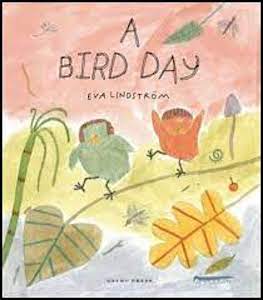 It’s an ordinary day for the bird family. The young ones, Lena and her little brother Bo, play, sing, hunt mosquitoes, and talk about their legs and toes. They have worm pie for dinner. Bo picks out the worms and only eats the pie shell. At night they fall asleep in their nest. Watercolor, gouache, and pencil illustrations show the funny facial expressions and cute hairstyles of the birds. The details in the family’s home are offbeat and interesting. This gentle story reflects on human behavior through this humorous bird family. mjw
 Set in 1980s Vietnam, Tho and his best friend, Lam, love cricket fighting, and soccer, but there is fear in his village that twelve-year-old boys, like them, will be conscripted into the Communist army. People are trying to leave Vietnam and move to safer countries. One day, Lam and his brother disappear. Tho’s family sells their furniture to make money to send Tho and his brother, Vu, away. Vu leaves first and a year later Tho boards a small boat to escape. He stows away on a pirate boat, crosses the South China Sea, and eventually gets to a refugee camp in Palawon in the Philippines, where he stays for six months. Finally, a Canadian elementary school teacher adopts him and he flies to his new home in Toronto. This harrowing story is based on true events in the author’s life. A map, a pronunciation guide, an afterword, and a brief recent history of Vietnam further enhance Tho’s intense account of his journey.