
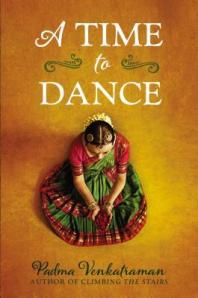
 Teenage Veda, who studies classical Indian dance Bharatanatyam, is injured in a car accident and her leg has to be amputated below the knee. She is devastated, but an American doctor understands her love of dance and designs a special prosthetic limb for her. Veda starts dancing all over again. She meets Govinda, a student teacher, who shows her a new way to bring joy to her dancing and who becomes her love interest. This enthralling story of Veda’s journey and of familial relationships in modern India is told in verse that captures the fascination of India. mjw Teenage Veda, who studies classical Indian dance Bharatanatyam, is injured in a car accident and her leg has to be amputated below the knee. She is devastated, but an American doctor understands her love of dance and designs a special prosthetic limb for her. Veda starts dancing all over again. She meets Govinda, a student teacher, who shows her a new way to bring joy to her dancing and who becomes her love interest. This enthralling story of Veda’s journey and of familial relationships in modern India is told in verse that captures the fascination of India. mjw |
| Title: A Time To Dance Author: Padma Venkatraman Publisher: Nancy Paulsen Book, an imprint of Penguin Young Readers Group Copyright: 2014 Original language: English ISBN: 978-0-399-25710-0 Hardcover pages: 320 Age range: 12 up Genre: Novel in Verse/Poetry Book setting: India Author’s ethnicity: Indian Author’s residence: United States Awards: 2015 South Asia Book Award – Honor, Grades 6 and up Subjects: Amputees, Dance, India, Novels in verse, People with disabilities, Southern Asia |
A Time To Dance
Leave a reply
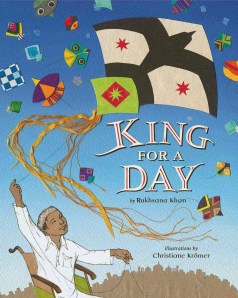 Malik, a boy in a wheelchair, does batter with other kites in the Basant festival from his rooftop in Lahore, Pakistan. With Falcon, his specially built-for-speed kite, he captures many kites including two flown by the bully next door. His good natured spirit shines through when the bully takes a young girl’s kite and Malik, as king for the day, helps the girl. Cut paper, yarn, Pakistani fabric, ribbon and pencil sketch collage illustrations from varying perspectives provide a kite’s eye view of the festival. A pronunciation guide and an afterword about the celebration of Basant are included in the book, and a teacher’s guide is available on the
 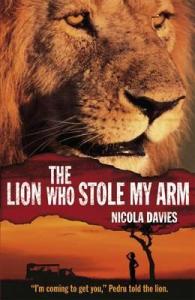 Young Pedru, who lives in the village of Madune in Mozambique, loses his arm when a lion attacks him. As he recovers, he strengthens his drawing talent and his desire for revenge. He accompanies his father on a lion hunt and mistakenly kills a lion wearing a tracking collar. This leads him to a conservation research center where he learns to look at the relationship between lions and farmers in a different way. Black and white illustrations and simple language convey Pedru’s story. Helpful footnotes explain African flora and fauna. An afterward, “Living with Lions,” contains factual notes and information about the Niassa Carnivore Project of Mozambique. This book is the first in a series of books which combine real animals and conservation in fictional stories. mjw
 OmniLibros