There was a time in the forest when the animals lived together in peace and harmony. But little by little the outside grew around them and the forest seemed to grow smaller and smaller. The animals couldn’t stand it anymore and soon there were quarrels. An emergency committee came up with a solution to restore peace. Some animals would be active during the day and sleep at night. Others would come out at night and sleep during the day. Since nobody volunteered to take the night shift, the committee selected animals to be the night creatures. However, the reason why we have daytime and nocturnal animals is not how it is told in the story. The book’s real message is that deforestation has caused the disappearance of one-third of our forests. The realistic-looking animals and bright colors rendered in ink and watercolors with rubbings and stamped textures are very appealing. The book is printed on “stone paper,” a special paper made of limestone. The paper doesn’t come from cutting down trees, doesn’t use water, and doesn’t need harmful chemical products. A final note tells more about deforestation and things we can do to save our forests. mjw There was a time in the forest when the animals lived together in peace and harmony. But little by little the outside grew around them and the forest seemed to grow smaller and smaller. The animals couldn’t stand it anymore and soon there were quarrels. An emergency committee came up with a solution to restore peace. Some animals would be active during the day and sleep at night. Others would come out at night and sleep during the day. Since nobody volunteered to take the night shift, the committee selected animals to be the night creatures. However, the reason why we have daytime and nocturnal animals is not how it is told in the story. The book’s real message is that deforestation has caused the disappearance of one-third of our forests. The realistic-looking animals and bright colors rendered in ink and watercolors with rubbings and stamped textures are very appealing. The book is printed on “stone paper,” a special paper made of limestone. The paper doesn’t come from cutting down trees, doesn’t use water, and doesn’t need harmful chemical products. A final note tells more about deforestation and things we can do to save our forests. mjw |
| Title: Agreement Under The Stars Author: Susana Rosique Illustrator: Susana Rosique Publisher: Cuento De Luz. Madrid,, Spain Copyright: 2024 Original Language: Spanish Translator: Jon Brokenbrow Original Title: Acuerdo jajo las estrellas ISBN: 978- 84-19464-82-8 Hardcover pages: 38 Age range: 4-8 Genre: Picture Book Author’s ethnicity: Spanish Author’s residence: Spain Illustrator’s ethnicity: Spanish Illustrator’s residence: Spain Subjects: Cooperation, Deforestation, Empathy, Forests, Harmony, Nocturnal animals, Parable, Peace, Solidarity, Survival, Sustainability |
Agreement Under The Stars
Leave a reply


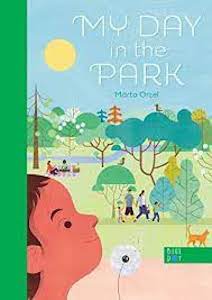 There is so much to explore in the park! Stop at the bandstand, the playground, the garden, the woods, the greenhouse, the pond, the petting zoo, and more. Discover exciting activities like horseback riding, tai chi, tightrope walking, soccer, and even hula-hooping. Look for a chihuahua, swans, ducks, caterpillars, pigeons, ponies, and a llama. At the end, choose a form of transportation from a busy city map to travel back home or play a memory game to test new vocabulary. There are 200 words for children to learn in the book- names for plants, birds, picnic foods, and much more. The colorful, detailed illustrations of this park trip use a variety of artistic techniques and provide an almost picture dictionary of a park. mjw
 Narrated by a young refugee, this beautiful and realistic picture book tells about having to leave home and the healing power of hope. The girl and her mother used to live in an apartment with a star-shaped lamp in their window. In their new country, everything is different – the language, their apartment, and the food. One day, the mother brings home art supplies so that they can make a cardboard star just like the one they had back home. That helps to make their new place feel a little more like home. The penultimate page shows the girl with a new friend, both carrying their musical instruments. The mostly blue and yellow illustrations were created with hand drawn contours and Photoshop. An author’s note explains that the book was inspired by Desnitskaya’s experience leaving Russia after the start of the Ukraine War. It is the author’s hope that his book can help children from different countries who have lost their homes to start loving the place where they were forced to be.