
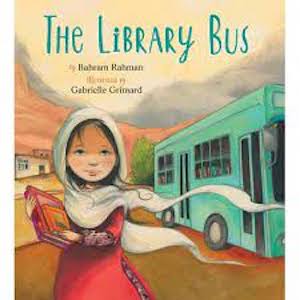
Author Bahram Rahman grew up in Afghanistan during the civil war and Taliban regime of 1996-2001. His story was inspired by the first library bus in Kabul that brought books to girls in remote villages and refugee camps who had no other access to education. Five-year-old Pari is starting her first day as her mother’s helper on the library bus. The girls in the villages and camps are learning English, but Pari cannot even read or write in Farsi yet. She is lucky that she will attend school next year. Her mother had to learn in secret because not long ago, girls were forbidden to read. The captivating watercolor and digital media artwork portrays the girls’ smiling faces, the rich landscape of Afghanistan, and the power of education. Included are notes about refugee camps and the author’s experiences in Kabul. mjw |
| Title: The Library Bus Author: Bahram Rahman Illustrator: Gabrielle Grimard Publisher: Pajama Press. Toronto Copyright: 2020 Original Language: English ISBN: 978-1-77278-101-4 Hardcover pages: 32 Age range: 5-8 Genre: Picture book Book setting: Kabul, Afghanistan Author’s ethnicity: born in Kabul, Afghanistan Author’s residence: Ontario, Canada Illustrator’s ethnicity: born in Montreal Illustrator’s residence: Canada Awards: 2021 Governor General’s Literary Award, 2021 Middle East Book Award Winner, 2021 Sout Asian Book Award – Highly recommended book Subjects: Books, Education, Libraries, Homelessness, Middle East, Poverty, Reading, Refugees |
The Library Bus
Leave a reply


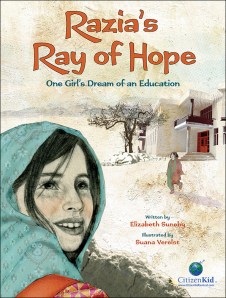 When young Razia learns that there will be a new school for girls in her Afghan village, she is determined to attend. Her baba gi (grandfather) supports her, but her father and brothers refuse to give her permission. The school’s founder assures them that Razia will be safe and that allowing her to go to school will be for the good of the family, the village, and the country. The book is a fictionalized account of the building of the Zabuli Education Center, a school for girls in the Afghan village of Deh’Subz. The story is enhanced by photo, fabric, and drawing collage. Illustrations capture the beauty and harsh realities of the small village. Background information on the lack of girls’ education worldwide; a brief biography of Razia Jan, the school’s founder; a glossary; and classroom activities accompany this powerful book. mjw
 OmniLibros